Showing posts with label Gorillas. Show all posts

Brothers in arms: The touching moment two hugging gorillas were reunited in their park enclosure after nearly three years apart

•Kesho the gorilla was separated from his brother Alf after he was chosen to take part in a breeding programme
•But the brothers acted as if they had never been apart when they were reunited at Longleat Safari Park in Wiltshire


By Rob Preece

Embrace: Gorillas Kesho and Alf embrace give each other a hug after being reunited at Longleat Safari Park

As some stressed parents know only too well, brothers don't always get on.

But when these two gorillas were brought together for the first time in almost three years, they hugged as if they had never been apart.

Kesho and his younger brother Alf recognised each other instantly as they set up home at a new £3million gorilla enclosure at Longleat Safari Park in Wiltshire.

Welcome: Kesho is settling in well with his brother at the safari park

Thirteen-year-old Kesho and nine-year-old Alf were raised in captivity together, but they were separated in 2010 when the elder sibling was sent to London Zoo as part of a breeding programme.

Kesho was sent back after he was found to be infertile, but his time spent in female company caused his appearance to change significantly.

His rise in testosterone levels gave him a silverback, his weight increased by 200lbs and his neck and head also grew in size.

These changes weren't a problem for Alf, however. He exchanged handshakes and laughter with his elder brother during the reunion.


Long time, no see: Kesho and Alf shake hands after being brought together for the first time in years

Home: The brothers are kept in a £3million gorilla enclosure at the safari park

Mark Tye, head gorilla keeper at Longleat, said: 'We weren’t entirely sure that the brothers would even know each other, but the moment they met you could just see the recognition in their eyes.

'They were touching each other through the cage that temporarily separated them and there were no acts of aggression.

'We put them together 24 hours later and it was like they had never been apart.

'They were very animated and there was a lot of rough and tumble on the floor, but not in an aggressive way.

'It is quite unusual to see that sort of childlike behaviour in a silverback.'

Mr Tye said that Kesho was very tolerant and the gorillas had formed a 'really tight bond'.

Like old times: Staff at the safari park say the gorillas are behaving as though they have never been apart

Family resemblance: The brothers were raised together at Dublin Zoo, but became separated when Kesho was chosen for a breeding programme

He added: 'Had they been two strangers there would have been a lot of face to face confrontation and some fighting and screaming.

'But Kesho and Alf were happy to turn their backs on one another which is a sign of trust.

'It is great for Alf to have an older brother to look up to and learn from and Kesho seems to enjoy being the centre of attention.

'It was very satisfying to see.'

The brothers were born at Dublin Zoo but parted when Kesho joined three females in London.

Longleat has set up a ‘bachelor group’ of gorillas as there are too many males in the European Association of Zoos and Aquaria breeding programme.


source:dailymail

Astonishing pictures of the young gorillas who worked together to dismantle the poachers' trap that killed their friends

By Mark Prigg


Just days after a poacher's snare had killed one of their own, two young mountain gorillas have been spotted working together to take apart poachers traps.

Staff at the Dian Fossey Gorilla Fund were stunned when they spotted the plucky young duo, called Dukore and Rwema, destroying a trap in their forest home.

'Today our field staff observed several young gorillas from Kuryama’s group destroying snares!' Veronica Vecellio, gorilla program coordinator at the Dian Fossey Gorilla Fund's Karisoke Research Center, which is in the reserve where the event took place, blogged.

The astonishing moment when two young mountain gorillas were spotted working together to find and destroy traps in their Rwandan forest home.

'John Ndayambaje, our field data coordinator, reported that he saw one snare very close to the group; since the gorillas were moving in that direction, he decided to deactivate it.

'Silverback Vuba pig-grunted at him (a vocalization of warning) and at the same time juveniles Dukore and Rwema together with blackback Tetero ran toward the snare and together pulled the branch used to hold the rope.

'They saw another snare nearby and as quickly as before they destroyed the second branch and pulled the rope out of the ground.'

The pair we able to rip the snare apart without harming themselves.

Vecellio said the behaviour was unheard of.

'This is absolutely the first time that we've seen juveniles doing that,' she told National Geographic.

'I don't know of any other reports in the world of juveniles destroying snares.

'We are the largest database and observer of wild gorillas ... so I would be very surprised if somebody else has seen that.

''Today we can proudly confirm that gorillas are doing their part too!'

Staff at the park were still reeling from the death last week of a young gorilla called Ngwino who was caught in a snare.

The young animal was found too late by workers from Karisoke, and died of snare-related wounds.

Her shoulder had been dislocated during escape attempts, and gangrene had set in after the ropes cut deep into her leg.

The two young gorillas in Rwanda who were spotted taking apart poachers traps

Bush-meat hunters set thousands of rope-and-branch snares in Rwanda's Volcanoes National Park, where the mountain gorillas live.

The traps are intended for antelope and other species but sometimes capture the apes.

Poachers build the snares by tying a noose to a branch or a bamboo stalk, Vicellio said.

The gorillas were spotted near the Karisoke Research Center, located in the reserve where the event took place.

Every day trackers from the Karisoke center comb the forest for snares, dismantling them to protect the endangered mountain gorillas, which the International Fund for Nature (IUCN) says face 'a very high risk of extinction in the wild.'

She believes the snare busting team must have dismantled other traps.

'They were very confident,' she said. "They saw what they had to do, they did it, and then they left.

'Quite Ingenious'


A young gorilla at Ape Action Africa, based at the Mefou Primate Park near Yaounde, Cameroon. It homes orphaned primates, many of whose family are caught in snare traps. Luci is another Gorilla baby at the park. She has a full time Cameroonian carer, Jeanne who acts like a surrogate mother.


source:dailymail

Not quite the king of the swingers yet... Baby gorilla Kukena takes his first tentative (very wobbly) steps under mum's watchful eye

By Tom Gardner


Finding his feet: Little seven-month-old Kukena ventures away from his mother's side for the first time at Bristol Zoo since birth

Every mother knows there's a time when you have to let go and watch your children make their own way in life.

And it seems there's nothing different in the animal kingdom, as western lowland gorilla Salome keeps a watchful maternal eye on her seven-month-old son Kukena who leaves her side for the first time since birth.

The little primate summoned the courage to go off and explore his enclosure in Bristol Zoo.

Watchful gaze: Mother Salome keeps a cautious eye on the newly intrepid Kukena as he explores Bristol Zoo

Although still very wobbly, Kukena managed to pull himself up on to his back legs and can walked on all fours.

Mammal keeper Alan Toyne said: 'Kukena is making fantastic progress and is developing well.

'It’s great to see him starting to walk and becoming more independent, although he will be reliant on mum for a long while yet.

'He is getting more and more active but still stays very close to Salome who is still very protective, particularly when the other gorillas are around.

'She will let him venture a few metres away from her when they are alone, but keeps him much closer when the other young gorillas are around as they tend to like a bit of rough and tumble.'


Exploration: Kukena, a baby western lowland gorilla, is keen to take a look around his enclosure and can pull himself up onto his back legs and take wobbly steps on all fours under the watchful eye of his mum, Salome


Scampering off: Kukena seems to have got a taste for adventure after leaving his mother's side for the first time - but she's still close enough to keep an eye on the youngster as he wanders around his pen at Bristol Zoo

Maternal: Salome looks a little perturbed by her son's new found sense of adventure as she huddles in the corner of her pen while Kukena wanders off for the first time

As well as getting physically stronger, Kukena is also starting to nibble on soft foods such as banana in addition to drinking Salome’s milk, which he will continue to take until he is around three years old.

As well as Salome and Kukena, Bristol Zoo’s Gorilla Island is also home to silverback Jock, who is father to Kukena; Namoki, six; Komale, five; Kera, seven; and Romina, the zoo’s other adult female gorilla.

The name Kukena means 'to love” and comes from the language of the Lunda Tribe from north west Zambia.

The tribe originates from the Congo, where western lowland gorillas are found in the wild.

Kukena was born on September 27, 2011, by natural birth to Salome - her third baby at Bristol Zoo.


Growing up: Although still very wobbly, the western lowland gorilla pulled himself up on to his back legs and walked on all fours, under the watchful eye of his mother, Salome

Tentative steps: Little Kukena is still tiny and has not left his mother's side in the seven months since he was born at Bristol Zoo so his first steps were a big achievement

Her last baby, Komale, was born in December 2006 following a course of groundbreaking fertility treatment, pioneered by the zoo’s former head vet, Sharon Redrobe.

This time however, Salome conceived her baby naturally.

The gorillas at Bristol Zoo are part of an international conservation breeding programme for the western lowland gorilla, which is a critically endangered species.

All gorilla species are facing serious losses in the wild caused by a number of issues including forest destruction for logging, diseases such as ebola and the slaughter of primates for the illegal bushmeat trade.


New experience: Bristol Zoo's baby gorilla Kukena holds onto his mother's arm as he ventures out of his enclosure at Bristol Zoo's Gorilla Island


Time for tea: All that exploring made the pair hungry - Kukena is Salome's third baby at the zoo


source:dailymail

Hands off my banana! Grumpy gorilla mum finds favourite fruit too irresistible to share with baby son

He may be one of Ireland's most famous residents, and he might be about to celebrate his first birthday - but that doesn't mean Kituba the baby gorilla always gets his way. As these pictures from Dublin Zoo show, the infant was left frustrated after he tried to grab a banana from his mother Lena - who made sure she got to enjoy the snack herself. The stern mother was obviously in no mood for any monkey business and even struck a threatening pose for the cameras after devouring the treat. Out of reach: Kituba tries to get his hands on the banana, but mum Lena shows him who's boss The pair are residents of Dublin Zoo's Gorilla Rainforest, a £2.5million development consisting of 12,000 square meters of undulating forest that is the perfect habitat for the zoo's breeding troop of western lowland gorillas. Tomorrow the zoo will kick off a weekend of celebrations to mark Kituba's first birthday, when the rainforest will be transformed into a funfair filled with family activities. Kituba was born on March 30 last year weighing just 1.81kg. Keepers were initially unable to tell whether he was male or female because Lena was so protective of the infant. The birth was heralded as 'a great success for the European breeding programme for these critically endangered primates'. Mother knows best: Gorillas are known to be protective of their young - and clearly Lena is no exception Birthday boy is taken for a ride: Kituba gets a lift from his mother source:dailymail

I'm trying to cut down! The gorilla who can't stop gorging on carrots

By GRAHAM SMITH

Hungry: This gorilla at Moscow Zoo was determined to grab as many carrots as he possibly could come feeding time

Perhaps they had run out of bananas.

But this hungry gorilla remained undeterred when he stole his entire family's supply of carrots.

Clearly worried about getting his five-a-day, the animal was photographed grabbing the vegetables and running away from the rest of his clan.

He then hid in a corner and proceeded to eat the lot.


Alone time: The animal then hid away in the corner of his enclosure to eat his way through his stash of carrots

The hilarious moment at Moscow Zoo was captured by amateur photographer Olga Gladysheva, 37.

She said: 'A family of four gorillas live at the zoo - three adults and a baby.

'When the zookeepers bring them food, the gorillas run for their portion, which on this day happened to be a big bundle of carrots.

'The male took as many carrots as he could hold in hands and, as gorillas usually walk on four paws, he put as many carrots in his mouth as he could. He took the rest in one of his hands and ran away to hide.


Easy does it: His more patient family, meanwhile, slowly ate their carrots one at a time

'Both females and the baby were eating carrots near the feeder, absolutely calm, one by one, trying to feel the taste of each carrot.

'But there really weren't many left for them to eat as the male gorilla had eaten nearly all of them.'

Animal lover Olga added: 'The male gorilla is very funny - he slaps or pinches one of the females and then runs away - and females start to chase him with a lot of noise.


source: dailymail

The gorilla in our midst: The enchanting story of the couple who adopted baby Digit (and still let her share the duvet 13 years on)

By Kathryn Knight


Like most devoted parents, Pierre and Eliane Thivillon know their 13-year-old’s little idiosyncrasies inside out. She is partial to a milky coffee and a brioche for breakfast, while her favourite evening meal is a portion of leeks in a creamy sauce.

She prefers sparkling water to still, and absolutely loves her sleep, complaining vociferously if she gets woken up too early.

Yes, she has her moody moments — what teenager doesn’t? — but, in general, she has a calm and placid nature.

Want a bite? Pierre Thivillon offers the two-year-old Digit a snack. She has been part of the family for 13 years


Which is just as well because not only does their ‘little girl’ weigh 80k (12st 8lb), but she is covered in fur, and, were she so minded, she could kill
her ‘parents’ with just one over-zealous hug. Not that there’s much risk of that.

Because while Digit may be a fully-grown gorilla, for the past 13 years the Thivillons have raised her as lovingly as if she were their own daughter at their home in the hills west of Lyon, France.

And their bond, they insist, is as close and loving as that of any conventional (human) family.

While Digit spends her days swinging, scratching and parading around a roomy enclosure, each evening she tootles across a covered walkway into Pierre and Eliane’s bedroom where the house-trained gorilla hunkers down for the night alongside them, snuggled under a duvet.

Sweet dreams: Eliane Thivillon and Digit catch 40 winks. If Pierre rises early, the gorilla will often clamber into his place to snuggle alongside his wife


If Digit is thirsty, she has no qualms about shaking Pierre awake to get her a drink of water, and if he rises first she will often clamber into his place to snuggle up alongside his wife.

Once everyone is up and about, this rather unusual trio eat breakfast together as a family before taking a morning stroll.

It is an extraordinary situation; one that is believed to be unique in the world — and little wonder. Gorillas may be wonderful creatures to look at, but given their size and strength, not many of us would fancy keeping one as a family pet.
Not so the Thivillons.

‘With Digit, I am never afraid,’ says Pierre.

‘I trust her implicitly, and that goes both ways — she has enormous confidence in us too. If she gets a splinter in her hand she will come to me to remove it.

‘The other day she had pineapple between her teeth and held her mouth open so I could floss it out with a stick. She has never shown a moment of aggression towards us. She just likes us being with her.’

Digit at one-month. She weighed just two kilos (4lb 6oz), and her life hung in the balance as the Thivillons tried to nurse her back to strength


It’s certainly fair to say that Digit is as demanding as any human child (although in gorilla years she is, technically, a young woman now).

‘We cannot leave Digit overnight with anyone else, which means we haven’t be able to go out for 13 years,’ admits Pierre.

‘We haven’t had a holiday, or a night away. We haven’t been to the cinema, the theatre, or out for dinner. It would make Digit sad if we weren’t here, and if she is sad we are, too.’

Married for 43 years, and with no children of their own, the Thivillons have dedicated their lives to animal conservation, setting up a private zoo in St Martin La Plaine 39 years ago to provide a sanctuary for ill-treated wild animals from circuses, private homes and other badly-run zoos across the world.

Funded by visitor fees and donations, today it is home to more than a thousand animals, among them monkeys, gibbons, snow leopards, tigers and lions and eight other gorillas.

But it is Digit who will always have a special place in their heart and home. Not least as she was born there.

Monkey business: The eight-month-old Digit playing with her favourite cuddly toy


Digit’s mother, Pamela, also lives in the family zoo after she was rescued from captivity in Cameroon, but sadly had little maternal instinct for her baby when she gave birth in October 1998 and failed to feed her.

‘We watched anxiously for two days,’ says Pierre. ‘But Digit was starving, shrinking before our eyes.’

She was also being bullied by some of the other young males, who would drag her along the ground while her mother looked on impassively.

‘In the wild, Digit would have died but we couldn’t allow that,’ says Pierre.

‘We held out our hands to Pamela, and by doing so, asked her if she would give us her baby. She understood, and passed Digit through her food hatch.’

Digit weighed just two kilos (4lb 6oz), and her life hung in the balance as the Thivillons tried to nurse her back to strength. They knew they were taking on a huge commitment: gorillas are reliant on milk for the first three years of their life and once she was bottle-fed there would be little chance of her being returned to her mother.

Urbane gorilla: Digit aged four. The Thivillons have not had a night out for 13 years as they won't leave her alone


So, at just a few months old, Digit became part of the family, spending her every waking hour with the couple as they went about their work at the zoo.

If Pierre drove a tractor, Digit sat on his lap; if Eliane went to the post office in the village, she took Digit with her.

‘We did all the things you would do with a normal child,’ Pierre recalls.

‘We took her for walks, we played with toys, we read books with her. Sometimes Eliane took her for a drive through the countryside, although in the end that got too difficult because you can’t make her wear a seatbelt and she clambered all over the car.’

Initially, Digit slept on her own in a put-up bed in the office of the couple’s home. All this changed, however, when, aged two, she had to have an operation to remove an abscess from her stomach.

‘The night of the operation she was very woozy so we didn’t want to leave her on her own, so Eliane and I slept alongside her on put-up beds,’ Pierre explains.

‘We only intended to do it for two nights, but when we had settled her in on the third night and got up to leave, she reached up with each hand and pulled us both back. She didn’t want us to go. It was a case of “stay one more night, please”. And 11 years later we’re still there.’

Digit with Pierre and Eliane today. Married for 43 years, and with no children of their own, the Thivillons have dedicated their lives to animal conservation


The couple’s bedroom, meanwhile, remains totally unused.

Unsurprisingly, there have been logistical problems: as Digit got older — and stronger — allowing her to roam in a public space during the day became unsafe. She needed a new daily hangout, and Pierre decided the chimp enclosure might do the trick.

‘We couldn’t put her back in with the gorillas as Pamela could react badly to her,’ he explains.

‘Chimps and gorillas aren’t really natural bedfellows in the wild, but in captivity they can get on and at least this way Digit could socialise with other primates rather than be alone.’

A pattern was established: during the day Digit would play with her new friends, and at night Pierre would come to collect her and take her over to the family home, where she would cuddle up with the couple.

It is a pattern which has unfolded in more or less the same way for the past seven years, although these days Digit has her own enclosure directly linked to the house.

‘She comes over at 8pm and climbs through the window to our bedroom,’ explains Pierre. ‘She has something to drink and sometimes something to eat, and then she pulls her covers over her and goes to sleep.

‘Then every morning we have breakfast together before she goes back to her enclosure.’

Digit's affection for Pierre is immediately apparent


Until a few years ago they took her for walks around the wider environs of the zoo, courtesy of a strong lead, although this is no longer possible as Digit now weighs almost as much as Pierre and Eliane put together.

‘If she wanted to run for it I would not be able to stop her,’ he says.

Not that she would be likely too, for it seems Digit knows on which side her brioche is buttered. ‘She knows how to communicate with us and tell us what she wants,’ Pierre says.

‘Obviously she can’t speak but she understands a lot of what we say. If I am talking to Eliane about getting a drink for Digit she will put her finger to her mouth, and if she’s thirsty she makes a noise to attract our attention and makes the same gesture.

‘She also doesn’t like us talking when she’s trying to sleep, so if we chat for too long she gives a big sigh to tell us to shut up.

'Just because Digit has this wonderful bond with me and Eliane doesn’t mean she is sympathetic to humans in general. In fact it’s impossible to predict how she will react to individual people,’ Pierre explains.

‘We don’t know whether she reacts to smells, or something in people’s faces, but we’ve had situations where we have tried to introduce her to someone and she has gone mad and rattled the bars of her enclosure. Other times she makes a low noise which says back off. It could go either way.’

A wide strip of grass and fencing separates zoo visitors from Digit’s barred enclosure, and it is only under Pierre’s strict supervision that I am allowed to navigate my way towards her — albeit, still protected by bars.

Pierre tells me that there are two noises in the gorilla repertoire: a low grumble which is the gorilla version of ‘get out’ and a contented throat-clearing which serves as: ‘I don’t object to your presence.’

Happily I get the latter.

'Just because Digit has this wonderful bond with me and Eliane doesn't mean she is sympathetic to humans in general,' said Pierre


‘She seems OK with you,’ nods Pierre, and within a few moments Digit has crouched down on the grass alongside me and is peering out through the bars while smacking her lips with her fingers.

‘She is offering you a present,’ Pierre tells me — and sure enough, Digit is proffering a piece of grass from her teeth which, in gorilla etiquette, is a high honour. She then shifts her attention to my feet, which seem to fascinate her, stroking the nail varnish on my big toe through the bars.

It feels marvellous, although not as much as watching her with Pierre, for whom her affection is immediately apparent. When he enters her enclosure she wraps her arms around his legs before leaning upwards for a kiss. Does she see him as a father-figure?

‘It’s hard to know,’ he says.

‘We have raised her, we live together much of the time, but it’s hard to know whether she sees us as parents.’

Nonetheless, Pierre and Eliane are painfully aware of the consequences of Digit’s reliance on them. In the wild, gorillas live to around 35, but in captivity can make it to 50. As Digit is only 13 and Pierre and Eliane are in their late 60s, there is every chance they will die before her.

‘We do worry,’ Pierre admits. ‘We hope to be here for a long time yet but we know we won’t be here for ever and we have to find a way of re-integrating Digit into the gorilla world.’

It is a process that will take time, although plans are afoot: in recent years Pamela has had two other babies, Gypsy and Jade, with another male gorilla, meaning Digit has two half-sisters.

‘We are building a new enclosure where we hope we can house all three of them and, over time, encourage her to spend the night there. It will be a sad day for us, but an important one because it means that Digit will be independent.’

In time, they even hope she will have babies of her own. And just like any other parents, Pierre and Eliane relish the thought of their furry grandchildren.

‘It is our dearest wish for her,’ Pierre smiles.


source:dailymail

A guy and his gorilla: Huge beast treated like one of the family by zoo owner

By Emily Allen


Big love: Pierre Thivillon, owner of the zoo of Saint-Martin-la-Plaine, gets a kiss from adopted gorilla Digit


To describe your child as a gorilla is a bit rude to say the least.

But for French zoologists Pierre and Elaine Thivillon, who own a zoo in Saint-Martin la-Plaine near Lyon, this is exactly what their 'little one' is.

They have fostered a gorilla called Digit who was rejected by her mother and they now treat her as their own.

Right at home: Pierre and Elaine Thivillon pose with Digit at their bedroom window


In these adorable pictures she is pictured spending time with her 'parents' and even giving her 'father' a loving peck on the lips.

She is clearly very comfortable in their company and despite her enormous size and strength, the couple obviously have not the slightest fear of her.

The unusual addition to their family was born at the zoo in 1998, but her mother did not know how to breastfeed her.

The couple stepped in to bottle feed her but her health took a turn for the worse and she underwent two life-saving operations.

Digit, who weighs 80 kilos, could live for up to 50 years.

Time for a chat: A male gorilla at the zoo called Euro looks longingly at Mr Thivillon


Chilling: Mr Thivillon and Digit appear to be deep in conversation. The Thivillons adopted the gorilla when her mother was unable to feed her


source:dailymail

The gorillas in the midst of an Atkins diet plan: When fruit is scarce they load up on protein

By FIONA MACRAE

When fruit was thin on the trees, the gorillas gorged on protein-rich leaves, meaning that protein accounted for 30 per cent of their calories


Some might look like they could do with losing a few pounds, but it is unlikely your average gorilla has much idea about slimming.

That said, researchers have found a group of great apes are unwittingly following the Atkins diet.

A study shows that when fruit is scarce, mountain gorillas follow a low-carbohydrate, high-protein diet, similar to the Atkins plan followed by slimmers worldwide.

When fruit is plentiful, their diet is still protein-rich, but is more similar to that recommended by heart charities for health.

The observation comes from researchers who spent a year watching gorillas at Uganda’s Bwindi Impenetrable National Park, the Royal Society journal Biology Letters reports.


When fruit was thin on the trees, the gorillas gorged on protein-rich leaves, meaning that protein accounted for 30 per cent of their calories.

But between February and March and from June to July, when fruit was easy to find, protein made up just 16 per cent of their diet.

Jessica Rothman, of the City University of New York, said the balance during fruit periods was close to the current recommendations of the American Heart Association.

‘By contrast, when leaves dominated diets, 31 per cent of total energy is consumed as protein, a value close to the upper energy limit recommended for humans and similar to high-protein weight loss diets.’

The Atkins diet, which promoted swapping white bread and potatoes for fry-ups and steaks, was followed by millions.

However, it fell out of favour after being dogged by side-effects such as constipation and claims it could increase the risk of heart disease.


source: dailymail

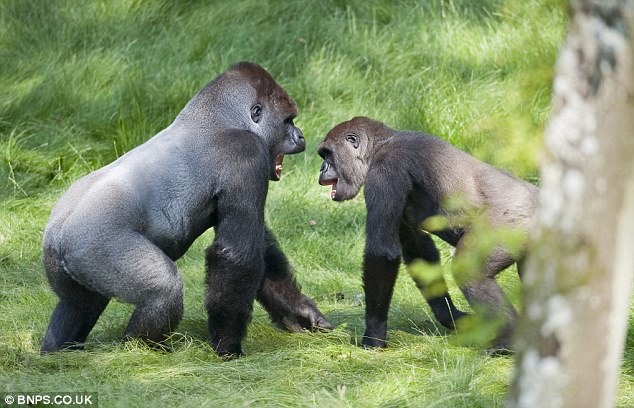
Fighting? No we're just monkeying around: Two lowland gorillas face up to each other... but it's just a bit of fun

By Daily Mail Reporter


Up close and personal: The two amazing lowland gorillas go head to head - but it's just for fun


This fantastic photo, taken by Paignton Zoo volunteer photographer Ray Wiltshire, shows eight-year-old male lowland gorilla Kivu and alpha male Pertinax, 29.

Kivu, on the left, weighs around 100kg and Pertinax tips the scales at a formidable 180kg.

But despite appearances, the two get on well and this was simply a bit of playful fun one afternoon.


Curator of Mammals Neil Bemment said: ‘Gorillas don’t live up to the King Kong image at all – they are mainly gentle giants - but they are no less impressive for that.’

The Zoo’s bachelor troop is one of the first established in Europe where young male gorillas can grow up in a social group if they are no longer in their original family groups.

The other members are Kumbuka 13, N’Dowe, 9, Kiondo, 8, and Matadi, who is also eight.


Two members of Paignton Zoo staff – Neil Bemment and primatologist Dr. Vicky Melfi - are on the steering committee of the EAZA (European Association of Zoos & Aquaria) Ape Campaign, an international push to raise one million euros and to increase awareness about the plight of apes in the wild.

The stomping grounds of lowland gorillas in the wild include the African countries of Cameroon, People’s Republic of Congo, Gabon, Equatorial Guinea and the Central African Republic.

They are famous for beating their chest, which many people mistake for a sign that they are about to go on the attack.

However, this action is actually a bluff that’s used to frighten intruders and doubles up as a way of enabling the rest of the gorilla’s band to run to safety.

Other human-like gestures that gorillas exhibit include clapping, bowing and stamping the feet.

Despite being so ferocious, the animals are mainly vegetarian, enjoying a diet of fruits, flowers and bulbs. They are also partial to ants and termites.

There are about 120,000 Lowland gorillas in the wild and they have a lifespan of between 20 and 50 years.

Paignton Zoo, meanwhile, is home to more than 3,000 animals, including baboons, crocodiles, Asiatic lions, giraffes and African elephants.

Leafy: Paignton Zoo has a huge collection of animals, including many exotic species

Animal magic: Paignton Zoo's resident baboon family


source:dailymail

Third tragedy hits London Zoo's gorillas: First two males die...

By DAILY MAIL REPORTER


Tragic: Tiny, seen here taking his first steps with his mother's help, died after a tussle with new silverback male Kesho


London Zoo's infant gorilla, nicknamed 'Tiny' by keepers, has died, it was announced today.

The development is the latest tragedy to hit the group of gorillas who live at the world famous site, in Regent's Park, after the deaths of two adult males in recent years.

Tiny, who was seven-months old, was the first gorilla born at the zoo in 22 years. He died after being injured by new silverback male, Kesho.


Careful: London Zoo had hoped the male gorilla would be a surrogate parent to the baby whose biological father died last year


Keepers had hoped Kesho would be a surrogate parent to the youngster after the death of his biological father Yeboah.

They had hoped the new silverback, who arrived last August, would bring balance and stability to the group following the tragedies.

While he had been gradually introduced to two of the females, Effie and Zaire, keepers waited until they were confident of a successful introduction to Tiny and his mother Mjukuu.

The first meeting on Wednesday ‘went very well’, according to the The Zoological Society of London (ZSL), but at a second attempt on Thursday Kesho asserted his authority.


New kid on the block: Staff had hoped Kesho would accept the new baby and integrate with the three female gorillas who live at the zoo


During a scuffle between the whole group, Tiny’s arm was seriously injured.

The gorillas were immediately separated, and the baby was taken to the on-site vet hospital, where it was confirmed his arm was broken and a three-hour operation to pin it began.

When vets brought him off the anaesthetic he was unable to breathe by himself, and vets suspected he had also sustained internal injuries during the scuffle.


Male gorilla Yeboah (left) died suddenly from diabetes in March 2010 – just five months after arriving at the zoo while his predecessor Bobby (right) also died unexpectedly in December 2008 following a heart attack


‘Everyone here is utterly devastated. Although we had tried to be prepared for the worst, we are all completely heartbroken by this.’

Keepers returned the baby’s body to Mjukuu so she could come to terms with his death.


Habitat:The group live at Gorilla Kingdom at London Zoo which has been designed to keep its inhabitants entertained


source: dailymail

Ape close and personal: Stunning images which capture primates at their most unguarded

By Daily Mail Reporter


Transfixed by the lens: Pangi, left, is a two-year-old bonobo who was born in Frankfurt Zoo. Right, other members of her family preen each other


Staring into the camera, they appear to be baring their soul.

These intimate portraits of apes at Frankfurt Zoo reveal a side of the animals rarely seen.

German photographer Volker Gutgesell has spent the past four years visiting the zoo's primate enclosure to capture the candid images.

Intimate portrait: Gorilla Rebecca, 27, has had eight babies and is also helping look after her sister Quemba to bring up her children


The 58-year-old says the years spent studying the bonobos, orangutans and gorillas has allowed him to pick up on their body language and take the perfect shot in a way few other photographers have managed.

Gutgesell started taking the images to help him cope with severe back pain caused by a slipped disc. He used to travel the world as a media manager until the injury in 2004.

Then in 2007 he developed tinnitus as a result of his injury, causing a constant ringing in his ears. But despite his condition, he has found a way of communicating through his pictures.

He said: 'I stand for many hours watching both the apes and the families that visit them.'

Eye contact: Galdikas, left, is one of four orang-utans at the zoo, and bonobo Heri, right, is also ten years old

Total control: A bonobo balances a nut in her lips


Peak of his powers and recent arrival: A male gorilla and a young bonobo at the zoo


'The more you watch them the more similarities you see between us and them.'

'Their movement is so strikingly similar to ours it becomes quite easy to read what's going on.

'Eye contact is very important - sometimes they see into the camera lens and become transfixed.

'The bonobos are funny creatures - they're my favourite.They live in a society where the males are ruled by the females.'

'So you see the males trying desperately to socialise as much as possible - by preening the females - they can't do enough for them!

'My urgent message is for us to learn from the gentle conduct of our animal relatives the primates.'


source:dailymail